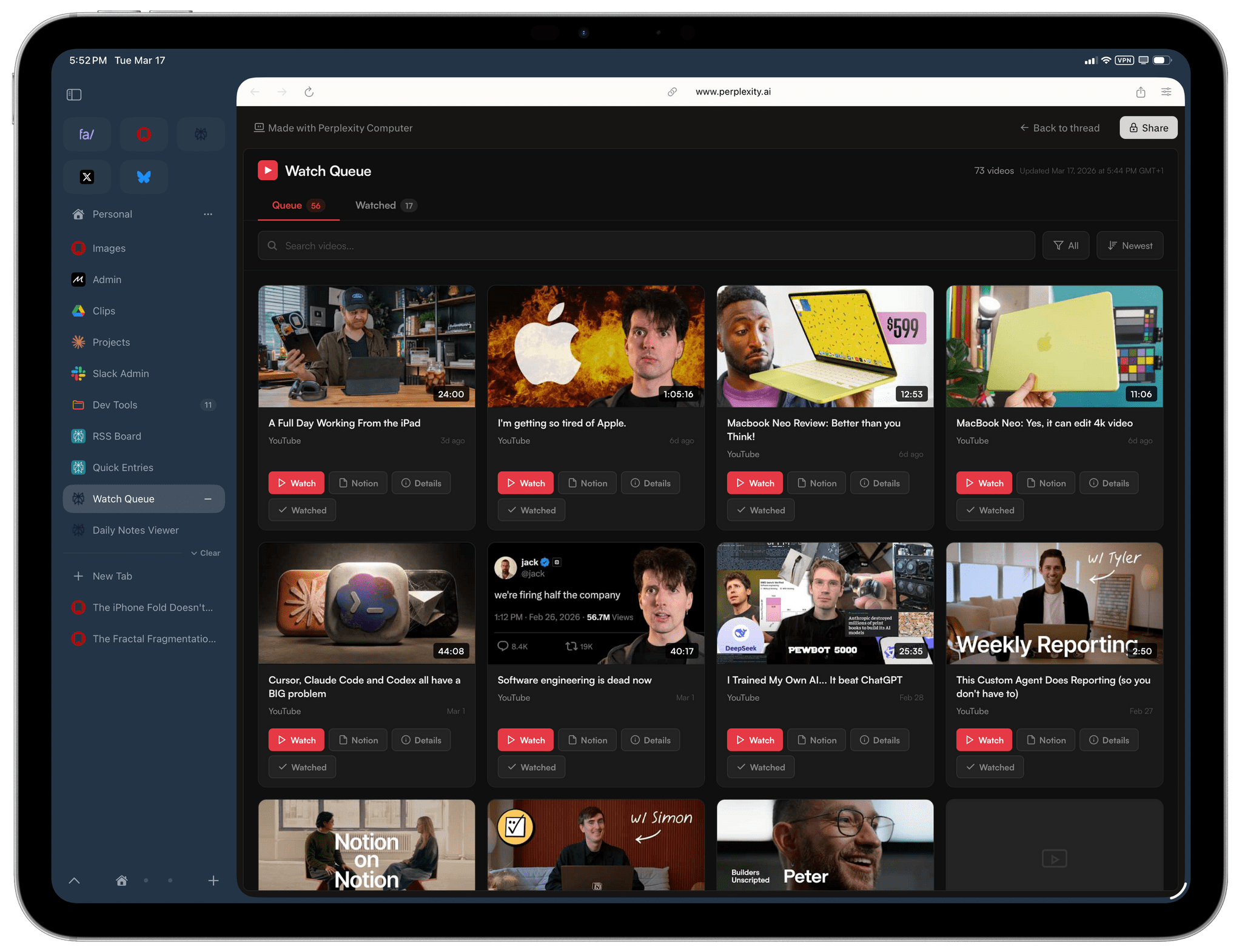
A New iPad Browser and Testing Perplexity Computer
The author details their experience testing Perplexity Computer, an orchestration layer designed to build and execute tasks, including web applications, directly challenging the capabilities offered by OpenClaw. This new offering from Perplexity aims to simplify the creation of agentic applications by providing a managed environment for searching, performing API calls, and generating documents. The core event is the direct comparison and evaluation of Perplexity Computer against the established OpenClaw framework for personal AI assistant development.
Perplexity Computer operates within a secure, sandboxed environment, consuming user credits, and offers a significantly easier onboarding experience compared to OpenClaw. It is fully rolled out across iOS, iPadOS, and Android, and features native connectors for integrating with external services like Notion without requiring direct API token management by the user. However, generated applications are confined to iframes within the Perplexity platform, require user login, lack custom icons, and currently do not offer a native secure keychain for direct API calls, contrasting with OpenClaw's self-hosted PWA capabilities.
This development introduces a critical divergence in the OpenClaw ecosystem, presenting a managed, cloud-based alternative to OpenClaw's local, self-hosted agentic deployments. Perplexity Computer emphasizes ease of use and sandboxed security, potentially attracting users who prioritize convenience over the deep customization and local control offered by OpenClaw. The upcoming Perplexity Personal Computer, a local instance, could further blur these lines, directly competing with OpenClaw's core value proposition of local agent execution and app deployment.
Developers focused on rapid prototyping and cross-platform deployment of agentic applications should pay close attention to Perplexity Computer's managed environment and native connectors. Operators evaluating infrastructure for AI agents will find this a crucial signal regarding the trade-offs between cloud-hosted, credit-based models and self-hosted, resource-intensive solutions. Researchers should observe how these competing architectures influence user adoption and the broader evolution of agentic AI frameworks.